"...entropy
brings changes and decay - |
regeneration
is the change, the
watcher is the decay..." |
|
Most
articles you read about DOCTOR WHO in most fanzines are conventional
- factual, relatively unbiased, and most comprehensive. Conventionally has an
obvious place in the way things are; but as I sit here writing this, I feel in
a rather uncongenial mood. Without I only hope that you enjoy it.
“A
kind of change came in my fate
My keepers grew compassionate
I know now what had made them so
They were inured to sights of woe,
But so it was:- my broken chain
With links unfastened did remain,
And it was liberty to astride,
Along my cell from side to side,
And up and down and then apart,
And tread it over every part;
And round the pillars one by one,
Returning where my walk begun,
Avoiding only as I trod,
My brothers’ graves without a sod;
For if I thought with heedless tread
My step profaned their lowly bed,
My breath came gasping and thick,
And my crushed heart felt blind and sick.”
(From THE PRISONER
OF CHILTON, Byron)
Remember LOGOPOLIS?
Leafing
theough the pages of a book of English verse, I am forced to. The extract from
Byron’s THE
PRISONER OF CHILTON looks to be some sort of explanation for that most
confusing of stories. The similarities are coincidental, perhaps? A change in
fate, a chain with broken links remaining (the Universe, preserved by Logopolis),
the cell’s pillars (the Cloister Room).
In MEGLOS,
Zastor said of the Doctor: “He seemed to see the theeads that bind
the Universe together, and have the ability to mend them when they break.”
But this is not
always possible.
Entropy increases
- as the Doctor says in LOGOPOLIS: “The more you put
things together, the more they keep falling apart: and that’s the essence
of the Second Law of Thermodynamics. And I never heard a truer word spoken.”
Is the Doctor
himself being affected by the entropy field?
MASTER: What
makes you think this program of the Monitor’s is going to work?
DOCTOR: Ah,
I don’t know. A sort of vague faith in the nature of things, I suppose.
MASTER: It’s
in the very nature of things for entropy to win.
DOCTOR: Yes,
but it’s the age-old battle isn’t it? Entropy versus structure. Still,
while there’s life there’s six of one and half a dozen of the other.
MASTER: Woolly
thinking, Doctor.
DOCTOR: Yes,
but very comforting when worn next to the skin!
Entropy or something
different? Entropy brings changes and decay - regeneration is the change, the
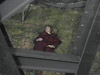
watcher is the decay. Has the Doctor avoided entropy by creating the Watcher
as an extension of himself theough Block Transfer Computation? Is that when he
net the Logopolitans first?
Perhaps we should
look back to his last regeneration:
DOCTOR: Lost
in the Time Vortex. TARDIS brought me home. Tears, Sarah-Jane? You mustn’t
cry. Remember, while there’s life, there’s….
A similar sentiment.
With life comes hope, and with hope comes a continuation of life. “One
good solid hope’s worth a cartload of uncertainties,” the Doctor
tells Adric in WARRIORS’ GATE.
The two DOCTOR
WHO stories by Chris Bailey - KINDA and SNAKEDANCE -
have both dealt with the dangers of trusting in science rather than pure faith.
Thus both stories warn of change: “Wheels turn, civilisations rise…wheel
turns, civilisations fall,” warns Panna, the wise woman.
“Cities
and Thrones and Powers
Stand in Time’s edge,
Almost as long as flowers,
Which daily die:
But as new buds put forth
To glad new men
Out of the spent and unconsidered Earth
The cities rise again.”
(CITIES AND THRONES
AND POWERS, Rudyard Kipling)
And
so, ‘change
is inevitable.’
But to return
to LOGOPOLIS - what does ‘Logopolis’ mean? “Need
it mean anything?” I hear you ask. “Does something like Gallifrey
mean anything?” Well, Bidmead’s other story is CASTROVALVA. ‘Logopolis’,
I think must come from two ancient Greek words, logox and psldx.
Transliterated to ‘logos’ and ‘polis’. So what? Well,
according to the Greek derivatives, ‘Logopolis’ means something like ‘city
of the word’. Their words - their calculative intones - have made the city.
But what does
it all mean? Probably not very much. But change is in the air: “It’s
the end but the moment has been prepared for.” A regeneration.
Perhaps the Doctor
knew it was going to happen, even before he had dipped into the future - told,
by the Watcher, of the ensuing catastrophe: “Events cast shadows before
them, but the huger shadows creep over us unseen. When some great circumstance,
hovering somewhere in the future, is a catastrophe of incalculable consequence,
you may not see the signs in the small happenings that go before. The Doctor
did however - vaguely.” (reproduced from the novel, LOGOPOLIS by
Christopher H Bidmead).
In LOGOPOLIS,
the Doctor describes the Cloister bell as, “a sort of communications
device reserved for wild catastrophes and calls to man the battle stations.” A
catastrophe begins, and the Cloister bells rings the changes.
But is this all
coincidental; As coincidental as the chain of circumstances that fragments the
law that holds the Universe together.
You
may feel that I’ve cheated a bit by including so many quotes in this article…but
it’s not meant to be a review or anything.
It’s an
appreciation. It’s not supposed to make a great deal of sense, either.
I just hope that you enjoyed reading it and it may, perhaps, have stimulated
some of your own views on that most of DOCTOR WHO stories - LOGOPOLIS.
As the Doctor says at the end of the LOGOPOLIS novelisation: “Well
that’s the end of that. But it’s probably the beginning of something
completely different.”
Edited for the online version of EOH by Matthew Walter.
|